
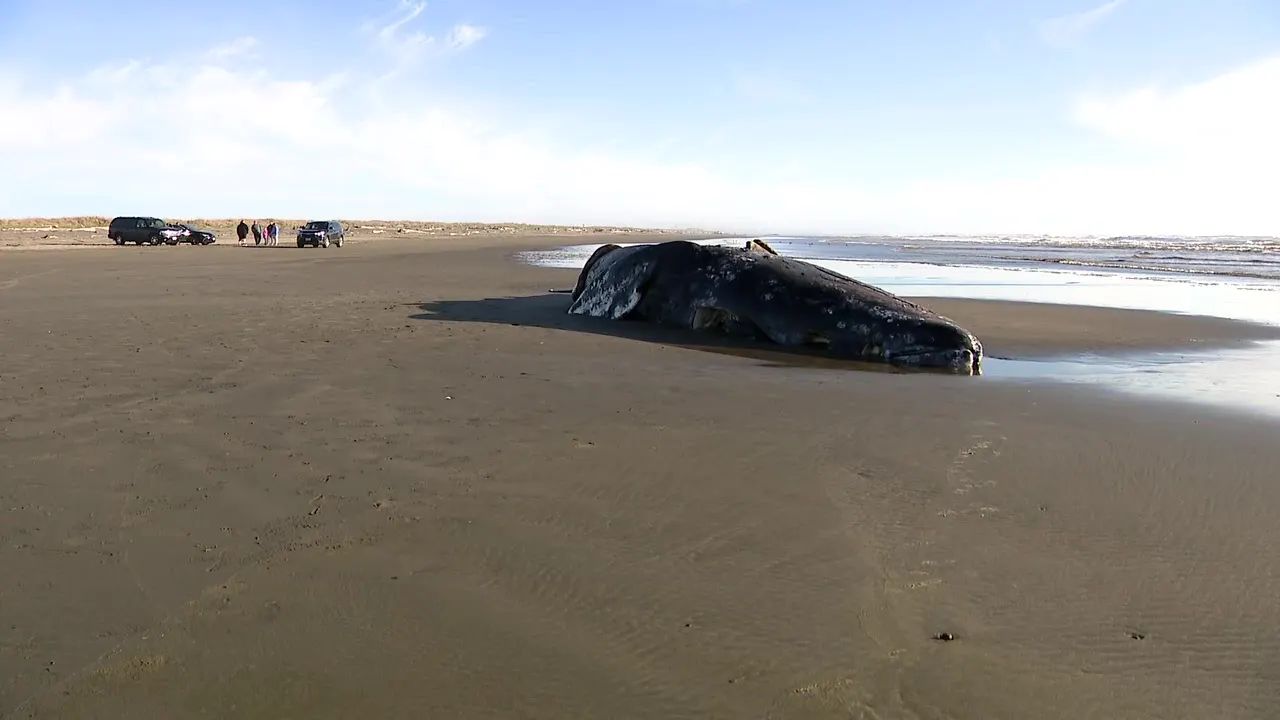
OCEAN SHORES, WA — A heartbreaking series of events has unfolded along the Washington coastline this April, as marine biologists confirm the deaths of three gray whales in less than a week. The discoveries, made in two separate locations, have raised urgent concerns among wildlife experts regarding the health of the whale population during their annual northward migration.
The string of fatalities began on April 1, when the Cascadia Research Collective began tracking a lone gray whale that had wandered into the north fork of the Willapa River.
The Willapa River Tragedy
Initial observations suggested the whale was behaving normally, though researchers noted it appeared thin. Hoping the animal would return to the sea on its own, a team monitored the river for several days. Plans were being drafted for a potential relocation if the whale remained stuck.
By Friday, April 3, the whale briefly disappeared, giving experts hope that it had found its way back to the Pacific. However, the optimism was short-lived. The whale was spotted again on Saturday, and by the time the team reached it, the massive creature had passed away.
A necropsy (animal autopsy) performed on Monday revealed a grim reality:
- Severe Malnourishment: The whale was extremely thin and in a debilitated state.
- Internal Injuries: Findings suggest the whale was too weak to navigate the river’s currents.
- Natural Decomposition: Experts decided to leave the carcass in the river to decompose naturally, providing nutrients back into the local ecosystem.
“Our necropsy results support the decision to not take immediate aggressive actions which would have further stressed the whale and not changed the ultimate outcome,” stated the Cascadia Research Collective.
Double Stranding at Ocean Shores
While teams were still processing the death in the Willapa River, another crisis emerged on Saturday at Ocean Shores, Washington. Two more dead gray whales were discovered washed up on the beach.
Biologists from the Washington Department of Fish & Wildlife and SR³ (Sealife Response, Rehabilitation & Research) joined Cascadia teams to investigate. The findings were equally concerning:
- The Male Whale: Along with being malnourished, the male showed significant head trauma consistent with a vessel strike.
- The Female Whale: Also severely malnourished. Experts confirmed she was not lactating, meaning no calf was left orphaned by her death.
Is There a Connection?
Finding three dead whales in such a short time and in close proximity might seem like a coordinated event, but scientists urge caution. Gray whales are solitary travelers and do not move in family groups.
According to Cascadia Research, the timing and location are likely a “tragic coincidence” driven by general migration patterns, tides, and ocean currents. However, the fact that all three were malnourished points to a larger issue: a lack of food sources in their feeding grounds in the Arctic, a problem that has led to an “Unusual Mortality Event” in recent years.
The Bigger Picture for Washington’s Wildlife
These strandings serve as a stark reminder of the challenges marine life faces—from climate-driven food shortages to the dangers of shipping traffic. Local authorities are asking the public to keep a respectful distance from the remains at Ocean Shores and the Willapa River for safety and out of respect for the ongoing research.
What do you think is the biggest threat to our marine life today? Is it climate change affecting food supplies, or human activity like boat strikes?