
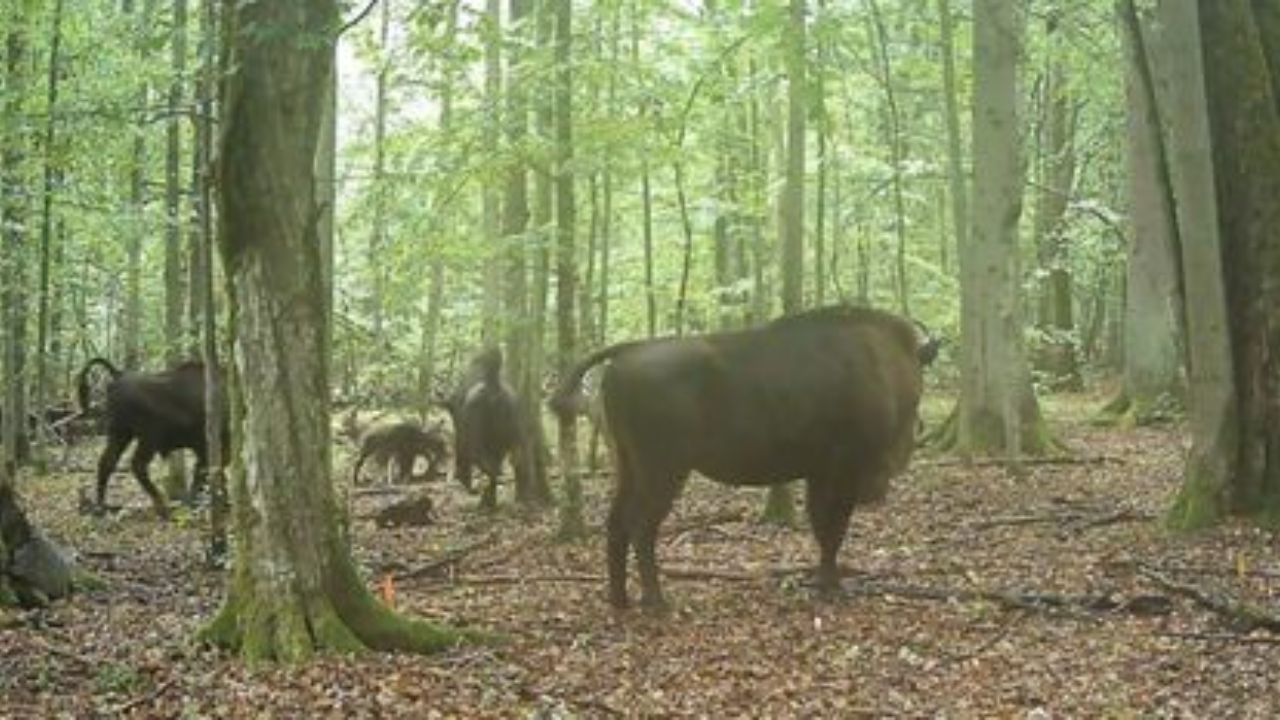
A rare camera trap video has captured a group of wolves attacking a European bison herd, a behavior scientists previously thought was nearly nonexistent in modern times.
The extraordinary event took place in the Białowieża Primeval Forest and was recently detailed in a study published in the journal Ecology and Evolution.
The Dramatic Forest Footage
The incident occurred on Sept. 15, 2025. A camera trap captured five wolves entering the frame, closely trailing three bison cows and a newborn calf.
In a tactical error, the adult cows chased after the wolves, leaving the vulnerable calf exposed. The pack immediately surrounded the newborn, biting its neck and attempting to drag it away. While two cows initially rushed back to rescue it, the wolves attacked a second time. Ultimately, the entire bison herd swarmed the predators, successfully ending the assault.
Challenging Wildlife Assumptions
The European bison, often called the “king of the forest,” has long been considered a non-prey species with no natural predators except humans. This footage completely changes that narrative.
“To our knowledge, we present the first video-recorded evidence of wolves attacking a European bison herd in the Białowieża Primaeval Forest,” researchers noted in the study.
While the video did not show a direct kill, scientists say it proves that wolf attacks on these massive mammals could potentially succeed.
The Białowieża Forest Population
The Białowieża Primeval Forest is the oldest and best-preserved temperate lowland forest in Europe, straddling the border of Poland and Belarus. It holds the world’s largest population of European bison:
- Polish Side: Home to over 870 bison.
- Belarusian Side: Home to roughly 730 bison.
Bison went extinct in the wild in 1919 but were reintroduced here in 1952. Since the mid-1990s, local wolves have strictly preferred easier prey like red deer and wild boar.
What This Means for the Future
Experts note that wolf packs in the forest are growing larger, likely due to a hunting ban enacted in the late 1980s. Bigger packs mean wolves can target larger prey.
If these attacks on young bison become more common, wolves could begin playing a natural role in regulating bison numbers. Researchers believe this natural balance could eventually help reduce growing human-bison conflicts in nearby communities.