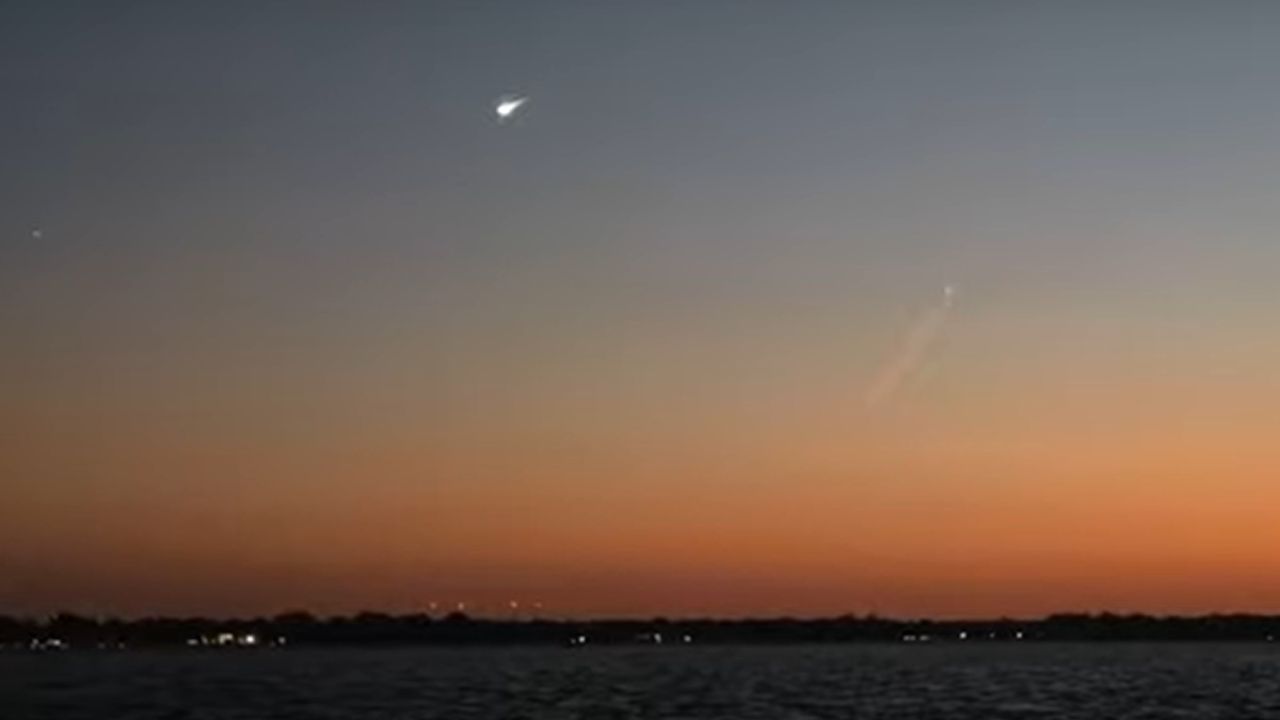
Chickasaw, Louisiana: A brilliant fireball streaked across the night sky above Chickasaw, Louisiana, on March 2, dazzling skywatchers across multiple Southern states and prompting dozens of eyewitness reports.
The meteor traveled at an estimated 30,000 miles per hour, covering more than 41 miles before disintegrating high above the Georgia Pacific Wildlife Management Area in Louisiana at an altitude of approximately 27 miles, according to observational data.
The rare celestial event was visible across Louisiana, Arkansas, Mississippi and Texas.
Meteor Seen Across Four States
Since the fireball lit up the sky, numerous witnesses have submitted reports to the American Meteor Society, detailing what they saw during the dramatic nighttime display.
Observers described:
- A bright, fast-moving object crossing westward
- A glowing trail behind the meteor
- A sudden flash before it disintegrated
The event occurred roughly 50 miles above northeastern Louisiana, making it visible over a wide region due to its brightness and altitude.
Security Camera Captures Stunning Moment
Home security footage from Walker, Louisiana, captured the moment the fireball streaked across the sky.
In the footage, the meteor appears as a bright, glowing object cutting across the upper portion of the sky, briefly illuminating the area before fading from view.
The short-lived but intense glow caught the attention of residents who quickly shared videos and reports online.
What Is a Fireball?
A “fireball” is the astronomical term for an exceptionally bright meteor visible across a wide geographic area.
According to the International Meteor Organization:
- Fireballs typically reach a visual magnitude of -3 or brighter.
- A magnitude of -5 is comparable to the planet Venus at its brightest.
- Under very dark conditions, a fireball can even cast faint shadows.
This Louisiana meteor met the criteria for classification as a fireball due to its intense brightness and visibility across multiple states.
What Causes a Meteor?
According to NASA, meteors — often referred to as “shooting stars” — are the visible streaks created when meteoroids enter Earth’s atmosphere at high speeds.
As they plunge through the atmosphere:
- Friction heats the object
- It begins to glow
- It may fragment or completely disintegrate
In this case, officials reported that the meteor fully broke apart before reaching the ground.
Not Linked to a Meteor Shower
NASA officials indicated that this particular meteor was not associated with any currently active meteor shower.
Instead, it was classified as part of the sporadic “background” meteor complex — random meteoroids that are not connected to known annual showers like the Perseids or Geminids.
Sporadic meteors occur regularly throughout the year and can appear at any time without warning.
Why Events Like This Capture Attention
Bright fireballs are relatively rare compared to ordinary meteors, which are often faint and visible only under dark skies.
Because this event:
- Occurred at high altitude
- Traveled a long visible path
- Reached significant brightness
It was widely seen and quickly reported by residents across state lines.
Astronomy experts note that while most meteors burn up harmlessly in the atmosphere, fireballs often generate strong public interest due to their dramatic appearance.
Conclusion
The March 2 fireball over Chickasaw, Louisiana, served as a striking reminder of the dynamic activity constantly occurring above Earth’s atmosphere.
Traveling at roughly 30,000 mph before disintegrating 27 miles above the ground, the meteor briefly transformed the Southern night sky into a glowing spectacle visible across four states.
Though not linked to a meteor shower, the event highlights how even sporadic meteors can deliver awe-inspiring displays — and how modern security cameras are increasingly capturing these fleeting cosmic moments.