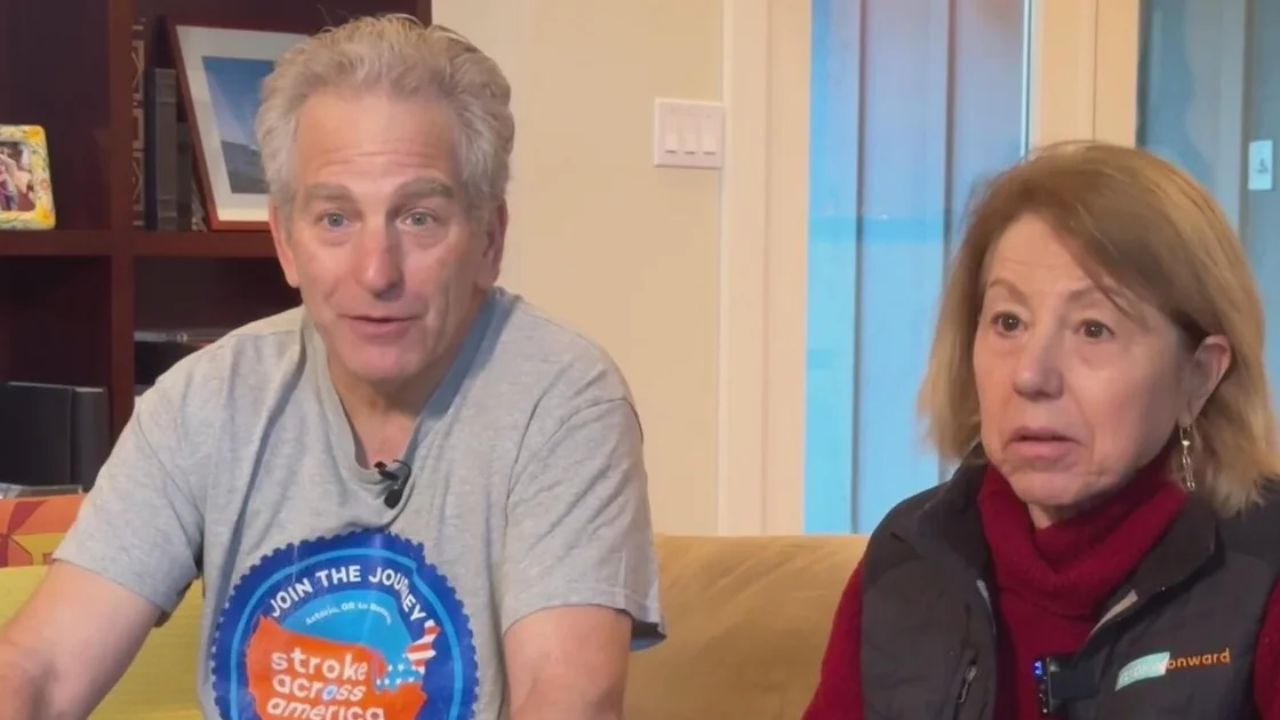
Redwood City, California – A Bay Area woman who survived a devastating stroke and her husband are transforming personal hardship into hope for thousands of others. Through a nonprofit they founded together, the couple is helping stroke survivors navigate recovery, identity loss, and life after disability.
Incident Overview
In 2010, Debra Meyerson, a respected Stanford academic, suffered a severe stroke while vacationing with her family in Lake Tahoe, California. What began as mild symptoms quickly escalated into a life-altering medical emergency that left her unable to speak and paralyzed on one side of her body.
Her husband, Steve Zuckerman, says the progression was frighteningly fast.
“By 8 o’clock in the morning, she couldn’t speak at all and was totally paralyzed on the right side. That was scary.”
Timeline of Events
Meyerson’s symptoms developed gradually the night before she was hospitalized. She went to sleep with slurred speech and mild physical limitations, unaware of how serious the situation would become by morning. After emergency treatment, she began a long and demanding recovery process involving physical therapy, occupational therapy, and speech therapy.
Determined to reclaim her life, Meyerson committed fully to rehabilitation.
“I am going to do everything possible to get better.”
While she successfully relearned how to speak, she did not regain the use of her right arm and was left with aphasia, a language disorder caused by brain damage that affects communication but not intelligence.
Details From Survivors and Officials
According to the Centers for Disease Control and Prevention, nearly 800,000 people suffer a stroke each year in the United States, making stroke a leading cause of long-term disability.
For Meyerson, the physical limitations were only part of the struggle. She was forced to give up her tenured teaching position at Stanford, triggering deep emotional distress.
“Three years after my stroke, I’m really depressed,” she said.
Zuckerman describes this phase as an identity crisis.
“It triggered the question, ‘Who am I now?’”
Key Facts About the Journey
- Stroke occurred: 2010
- Location: Lake Tahoe, California
- Lasting effects: Right-side paralysis, aphasia
- Career impact: Gave up tenured Stanford position
- Nonprofit founded: 2019
- Cross-country ride: 4,500 miles, 100 days, 2022
Rebuilding Identity Through Purpose
Refusing to surrender her intellectual identity, Meyerson decided to document the emotional side of stroke recovery. With support from her family, she co-wrote Identity Theft, a research-based book exploring how survivors reconstruct meaning after stroke. The first edition was released in 2019, after five years of work.
The book resonated deeply with other survivors, including Manny Gigante, who credits the couple with helping him overcome depression decades after his own stroke.
“There was no hope. But when I connected with others, that’s when I was at my best.”
Another reader, retired writer Mukul Pandya, said the book fundamentally changed his recovery outlook.
“Identity Theft saved my life. Recovery isn’t about going back to who you were. It’s about building a meaningful life around who you are now.”
Expanding Impact Through Stroke Onward
Inspired by these stories, Meyerson and Zuckerman founded Stroke Onward in 2019. The nonprofit focuses on the emotional and psychological aspects of stroke recovery, areas often overlooked in traditional rehabilitation.
Pandya now serves on the organization’s board, helping guide its mission.
In 2022, the couple took their advocacy nationwide through Stroke Across America, a 4,500-mile cross-country journey on a custom tandem bicycle completed over 100 days. Along the route, they hosted 16 community events, raising awareness about stroke recovery and aphasia.
“We wanted to do something meaningful with a dream we already had,” Zuckerman said.
“I loved it,” Meyerson added.
Ongoing Support and Awareness
In 2024, Stroke Onward launched the Stroke Monologues, live storytelling events where survivors share real-life recovery challenges. The organization also created the Stroke Onward Community Circle, a free online network of hundreds of survivors, caregivers, and medical professionals.
Their central message remains consistent.
“Hope, meaning, and purpose,” Meyerson said.
Zuckerman emphasizes that recovery is personal and adaptable.
“People can find meaning and purpose at whatever level of disability or ability they have.”
Conclusion
From a sudden medical crisis to a nationwide movement, Meyerson and Zuckerman’s journey underscores the power of resilience and community. Their work continues to reshape how stroke recovery is understood, proving that life after stroke can still be rich with connection, purpose, and hope.
If you or someone you love has been affected by stroke, awareness and shared stories matter. Share your experiences in the comments below.